January 16, 2026
Homes are meant to be safe, anxiety-relieving spaces that we can retreat to after a long day of work, school, or socializing. The space that when you walk through the door, you can feel most of the day’s stress lifting off your shoulder.
Oftentimes, though, our homes can add to our anxiety and overwhelm, which is a fast-track way to burnout and potentially mental health concerns. This can happen for a multitude of reasons, which I probably cannot comprehensively list here. These are things such as: visual clutter, homes not set up for our brains, the ongoing to-do and shopping lists, tending to the needs of pets or little humans, and more.
Sounds like a lot right? That’s because it is! Adulting is difficult. Add a neurodivergent brain on top of it, and it’s worse. Then, add an overwhelming home without a safe space, and we’ve set ourselves up for disaster.
I wish I could offer solutions to all of these issues or magically take away all of adulthood’s responsibilities, but sadly, I cannot. Believe me, if I could, I would have saved myself from lots and lots of burnout already!
So if waving a magic wand is out of the question, how do we fix at least some of these issues? One way is setting our home up to work for us, or, at the very least, creating a safe space to use when we need to decompress.
It is common for people, neurodivergent or neurotypical, to fall into the trap of organizing their homes in the most aesthetically-pleasing way or based on professional organizers’ recommendations. This isn’t to say it doesn’t work, but maybe it doesn’t work for you.
So, how do you create a sensory-safe space and/or home yourself?* Well, I’m so glad you asked!
*This blog is also applicable for parents or caregivers that are wanting to help create a space for a neurodiverse person.
1. Find a space that can mostly remain as your safe-space
This tip is first because it is super important. The purpose of creating a safe-space is so you can quickly access it when feeling overwhelmed and need to decompress or as a preventative measure before becoming overwhelmed. Therefore, the space cannot be its most effective if you are needing to set it up in the midst of feeling overstimulated. Items may come and go, or you may need to modify the space for various reasons and occasions. That is perfectly fine as long as it can mainly stay intact.
Let’s start small and think about finding a sensory-safe space only for you. We will talk about shared spaces later on, so for now, I only want you to think about making a space for yourself.
Think about these questions to determine the best spot to create your sensory-safe space.
1. Is there a spot that can be my designated safe space full-time?
2. What do I need from others when I’m overwhelmed? (comfort, space, talking through feelings, quiet, etc.)
3. What can I absolutely not tolerate when overstimulated? Think about all 5 senses (i.e., irritating sounds, scents, lights, items touching you, tight spaces, etc.)
4. Are there any safety concerns to account for? (items that can break, space for movement, things that may hurt, etc.)
1. Is there a spot that can be my designated safe space full-time?
2. What do I need from others when I’m overwhelmed? (comfort, space, talking through feelings, quiet, etc.)
3. What can I absolutely not tolerate when overstimulated? Think about all 5 senses (i.e., irritating sounds, scents, lights, items touching you, tight spaces, etc.)
4. Are there any safety concerns to account for? (items that can break, space for movement, things that may hurt, etc.)
Some other questions may come up for you, and that is great! These are just a guide to get you started! The space that comes to mind now may not be the one you stick with forever, and again, it doesn’t need to always be “perfectly ready to go” as long as it meets your needs when the time comes.
If your answers are leaving you feeling like there isn’t a space for you, don’t be discouraged. It may help to rank your answers to see what is an absolute deal breaker versus what’s annoying but tolerable. Your space doesn’t necessarily need to be in your home either. It could be your car, your porch, a shed, your garage, etc.
2. Create a space that brings you comfort
People will always have their opinions, which they are entitled to, but that does not need to determine how you set-up your sensory-safe space. When feeling overwhelmed or just needing a place to retreat to, it’s important to have things that make you feel good regardless of what other people think.
Maybe that means you have tons of stuffed animals on your bed, a mini-fridge in your closet, a swing permanently set up in your basement, or a completely decked-out sensory room. Whatever you do, it’s awesome because it works for you.
Some questions to consider which items to add to your space:
1. What helps me feel regulated? Think through all 5 senses (e.g., sensory defenders, weighted blanket, sensory sock, ice, heating pad, swinging, items to help get energy out, etc.)
2. What brings me joy or calm? (e.g., candles/essential oils, music, journaling, fun lights, reading, coloring, LEGO, puzzles, blankets, favorite article of clothing, stuffed animal, etc.)
3. Will any items likely leave the space often? (e.g., others need it, want it with you, belongs in a set, worn regularly, etc.)
4. Will I want or need to modify the space for any reason? (i.e., guests, regular use of the space, cleaning, etc.)
5. Can my space accommodate this item? (e.g., outlet is needed, enough space, additional furniture needed)
6. Could the item get ruined, and if yes, would that be upsetting? (e.g., getting wet, new smell, sun-bleached, etc.)
7. Does this create any safety hazards? (e.g., blocked exit/window, tripping hazard, fire hazard)
* If items pose a risk, especially when unattended, it may help to create a checklist for shutting down the space.
1. What helps me feel regulated? Think through all 5 senses (e.g., sensory defenders, weighted blanket, sensory sock, ice, heating pad, swinging, items to help get energy out, etc.)
2. What brings me joy or calm? (e.g., candles/essential oils, music, journaling, fun lights, reading, coloring, LEGO, puzzles, blankets, favorite article of clothing, stuffed animal, etc.)
3. Will any items likely leave the space often? (e.g., others need it, want it with you, belongs in a set, worn regularly, etc.)
4. Will I want or need to modify the space for any reason? (i.e., guests, regular use of the space, cleaning, etc.)
5. Can my space accommodate this item? (e.g., outlet is needed, enough space, additional furniture needed)
6. Could the item get ruined, and if yes, would that be upsetting? (e.g., getting wet, new smell, sun-bleached, etc.)
7. Does this create any safety hazards? (e.g., blocked exit/window, tripping hazard, fire hazard)
* If items pose a risk, especially when unattended, it may help to create a checklist for shutting down the space.
If you are struggling to create your space, it may help to ask people you are close to if they have any ideas!
3. Allow your space to be “unaesthetic” or “childish”
This tip kind of goes along with Tip #3, but I want to highlight, again, that this is your space. It is allowed to be whatever you want it to be. Plus, engaging in play or non-productive tasks is so important for combating burnout and just feeling joy in life!
If the space allows, add special interest items or play activities. Your sensory-safe space doesn’t need to only be for moments of overstimulation. You can use it to take care of yourself and be proactive against overwhelm and meltdowns. Your to-do list will be there when you’re done, so please prioritize your needs and don’t let the responsibilities of life control you!
Examples of play activities may include:
- A sensory table or jar/bottle
- Water play
- Play-Doh or slime
- Swinging
- Coloring
- Blowing bubbles
- Toys (cars, animals, dolls, cause-and-effect, etc.)
- Building (LEGO, puzzles, blocks, etc.)
- A sensory table or jar/bottle
- Water play
- Play-Doh or slime
- Swinging
- Coloring
- Blowing bubbles
- Toys (cars, animals, dolls, cause-and-effect, etc.)
- Building (LEGO, puzzles, blocks, etc.)
It might feel silly at first, but sometimes silly is what we need to get our body out of the fight or flight zone!
4. Modify the spaces you already have
As you think about setting up your sensory-safe space, keep the spaces you already have in mind! Maybe you have a craft room or gaming room, a comfy couch or beanbag in your living room or basement, or you find your bedroom comforting. Creating your space doesn’t require clearing out an entire room or closet!
If you have a space that you naturally retreat to, use it! Maybe it just needs some modifications to fully cover your sensory needs!
As an example, when I am overwhelmed, I usually gravitate towards sitting on the couch. It’s comfy. There’s an armrest and a bunch of pillows (and now stuffed animals) that surround me for a nice little squeeze. There’s an end table next to it.
Retreating to the couch has been a common occurrence for me since graduating college, but it has not always been a sensory-safe space and sometimes even created further escalation. I had to evaluate the space a lot to figure out how to make it work for me.
Upon reflection, I discovered a few things.
1. If there weren’t some stimulating/interesting items around the couch, it was really easy for me to get stuck in my thoughts and, therefore, stuck on the couch for a long time and for me to further escalate.
2. I had items that helped me stay regulated, but they were in terrible spots because I wanted the space to seem adult-ish and organized. However, I often forgot about the items or couldn’t access them when I needed them.
3. I had mixed feelings about going to the couch because it did not always help me calm down, so I was trying random spots that didn't have helpful items or subjected me to an ambush of kisses from my dogs (talk about overwhelming)!
4. I really don’t like the look or texture of certain pillows we have.
To fix these issues, I decided the couch needed to be my consistent sensory-safe space and stopped using other spots unless absolutely necessary. I also adjusted the following aspects to make it a better spot:
1. I sit in a spot on the couch where I can choose to turn away from the rest of my house or face it. We also have some of my preferred activities in view/reach. This gives me plenty of options to choose from when de-escalating and the option to get up or stay on the couch.
2. For this space only, I got over the idea that I need everything to look adult-ish. I now have plenty of stuffed animals surrounding me to avoid the bad pillows and to use as regulation tools. The end table also houses my bin of fidgets, headphones, and water for easy access!
3. I am more consistent about coming to the couch when overwhelmed, and because I have so many regulation tools available, it’s helping me to regulate quicker too! I can’t always avoid the dog kisses, but it’s way more manageable.
4. If we have company, I can easily clean and organize the items on and next to the couch to accommodate guests without sacrificing the functionality of my sensory-safe space.
This is just one example that shows how a few small tweaks to an existing space made a huge difference to my ability to stay regulated without completely creating a new space. Use the questions from Tip #2 to determine what tweaks could be make to your space!
I also use this example to show how a shared space can be used if that’s what you want or need! It can be scary to ask for accommodations from the people you live with, but if you think a shared space will offer the best sensory-safe area for you, then it can be worth the discomfort of asking. Then, you all can create a plan for how to best utilize the space and still make it accessible for everyone.
5. Don’t completely reorganize your home!
At the start, I mentioned that visual clutter and a home organized in a way that doesn’t work for you can contribute to stress and overwhelm. While this is true, it doesn’t mean you need to completely reorganize your home right now. Us ADHD/AuDHDers, know that this just leaves you sitting amongst Doom piles at 2am questioning your life.
After creating your sensory-safe space, you may consider slowly reducing visual clutter and reorganizing in your home. Slowly. This can be done over several days, weeks, months, or years. It may take time for you to learn what works for you and modify as you go.
To reorganize and reduce visual clutter, you may:
1. Find a designated spot for items that just seem to live on your counter or tables
2. Gather items of the same type, store them together, and tell everyone where they live now
3. Donate or toss items that aren’t being used
4. Put items where they are most helpful to you and not where people think they should go. Examples:
a. If you struggle putting clips on chip bags because you never remember which drawer they’re in, put them in a small bin on the chip shelf.
b. If you forget to take your medicine because it’s hidden in a medicine cabinet, put them on your nightstand where you can see them.
c. If you’re fighting morning grogginess and struggling to make coffee because the beans are in your pantry but your machine is on the counter, put it in the cabinet above the coffee maker or on the counter next to it (watch out for visual clutter though)!
Just remember that organizing to reduce stress does not require complete upheaval of your home. It is possible to organize one room, cabinet, or type of item at a time!
Final Thoughts
However you make your sensory-safe space, the most important thing is that you make it yours! Make it work for you, and don’t care about what other people think of it. This space is meant to help you feel safe and calm and to accommodate your needs. It can be used to avoid overwhelm, to help you calm down, or however you’d like to use it really!
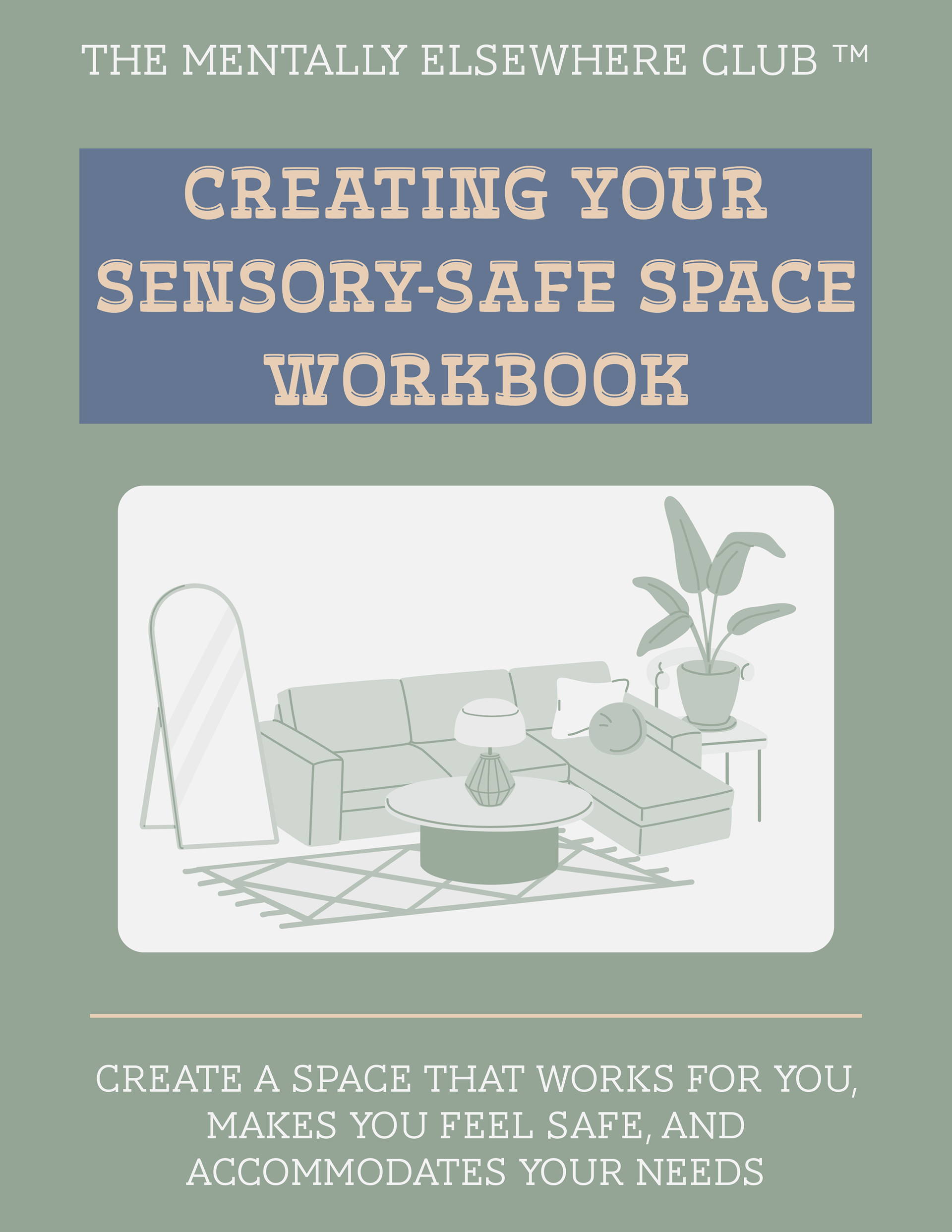
Click the image below to access our new workbook for creating a sensory-safe space. It will walk you through the content of this blog and provide space for you to jot down your thoughts!
If you have a great sensory-safe space you want to share, please feel free to send me an e-mail at egaeta@thementallyelsewhereclub.com or DM our social accounts. We would love to show off your space so it can inspire others' safe spaces too!